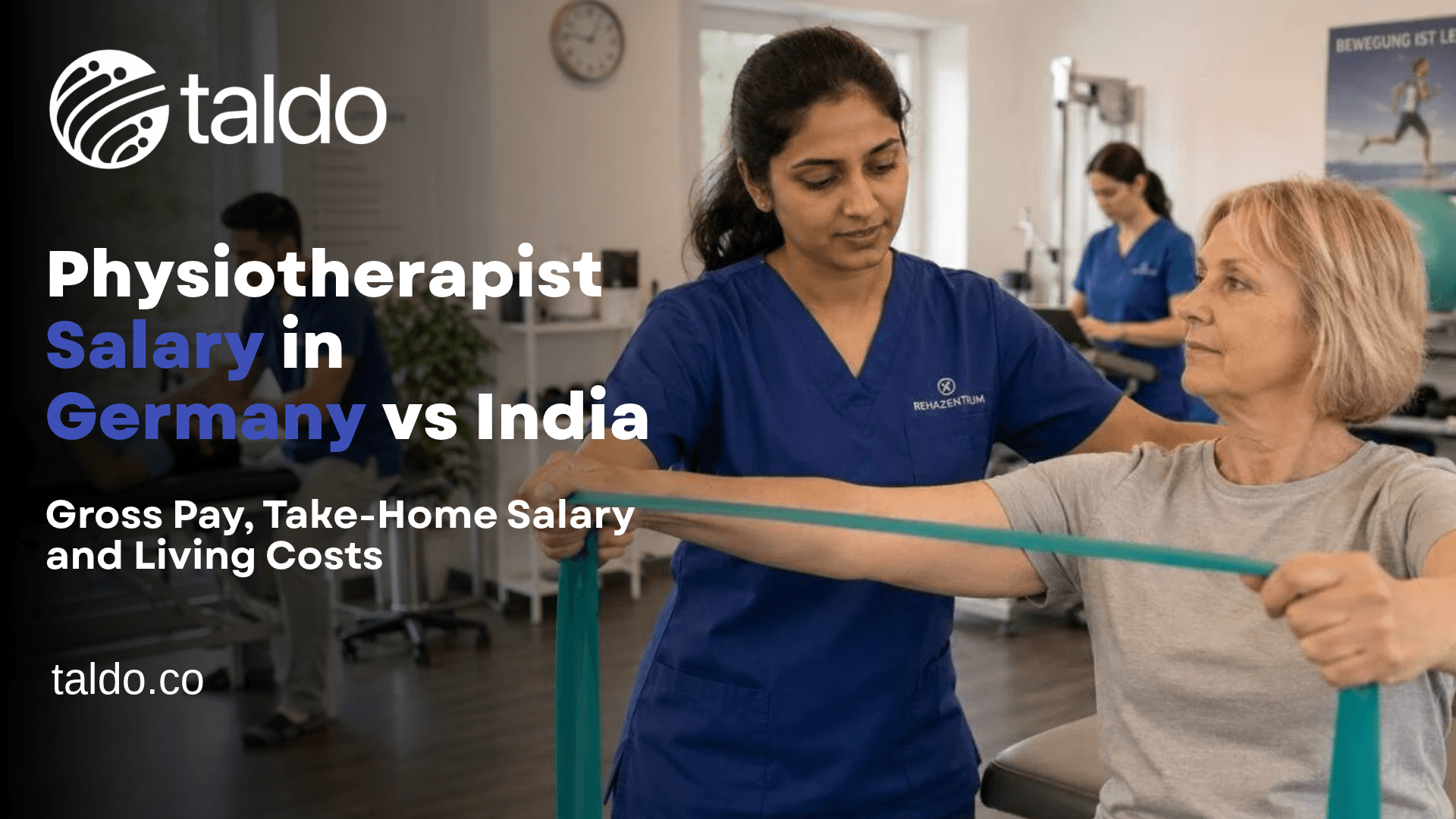
Physiotherapist Salary in Germany vs India: Gross Pay, Take-Home Salary and Living Costs
Fast Facts: Life in Germany
€3,200+
Starting Monthly Pay
5 Years
To German Citizenship
"If you are a physiotherapist in India weighing a move abroad, the first question is usually the simplest one: how much will I actually earn, and how much of it will I keep? Here is an honest, number-by-number comparison.
Salary headlines can be misleading. A figure in euros looks impressive next to a figure in rupees, but what matters is take-home pay after tax and social contributions, set against the cost of rent, food and transport. This guide walks through what physiotherapists earn in Germany and in India, what daily life costs in each country, and what the gap realistically means for your savings.
What Physiotherapists Earn in India
Physiotherapy pay in India varies enormously by city, employer type and experience. A fresh graduate working in a private hospital or a small clinic typically starts at a modest monthly salary, often in the range of ₹15,000 to ₹30,000. With three to five years of experience, specialisation in areas such as orthopaedics, neurology or sports rehabilitation, and a position in a larger hospital chain, many physiotherapists move into the ₹35,000 to ₹60,000 range. Senior clinicians, department heads and those running a successful private practice can earn considerably more, but this takes time and often an initial capital investment.
Several features of the Indian market shape the real value of these salaries:
- ✦Long working hours are common, and overtime is not always paid.
- ✦Salary growth is slow in many private settings.
- ✦Self-employment offers upside but carries risk, rent and marketing costs.
- ✦Government posts pay well and are secure, but entry is highly competitive.
What Physiotherapists Earn in Germany
Germany has a sustained shortage of rehabilitation professionals, driven by an ageing population and growing demand for post-operative and chronic-care therapy. Once your qualification is recognised, a physiotherapist in Germany can expect:
- ✦Gross salary: €3,400–€3,600 per month
- ✦Net take-home: approximately €2,300–€2,600 per month
The difference between gross and net comes from income tax and social insurance contributions covering pension, health, unemployment and long-term care insurance. These deductions also buy you something: statutory health coverage, pension accrual and unemployment protection, all of which you would otherwise pay for separately in India.
Germany also regulates working hours strictly. A standard week is around 38 to 40 hours, overtime is recorded and compensated, and paid annual leave is typically 25 to 30 days, plus public holidays.
What Shapes Your Pay Within That Range
The range of €3,400–€3,600 gross is a useful benchmark, but where you land depends on a few practical factors. Understanding them helps you compare offers sensibly rather than just chasing the highest number.
Employer type. Hospitals, rehabilitation centres, outpatient clinics and private practices all employ physiotherapists, and each structures pay slightly differently. Larger institutions often follow collective agreements with clear pay scales, which means your salary is transparent and increases predictably with experience. Smaller private practices may offer more flexibility but less standardisation, so it is worth asking exactly how your pay is calculated.
Location. Salaries are broadly similar across Germany, but your cost of living is not. A salary in a smaller town or a region with strong demand for therapists often stretches much further than the same salary in a major city, mainly because of rent.
Allowances and extras. Depending on the employer, you may receive supplements for weekend or shift work, employer contributions towards pension schemes, or support with relocation and housing in the early months. These do not always appear in the headline figure, so always read the full contract rather than comparing gross numbers alone.
Your tax class and personal situation. Your net income depends on your tax class, marital status and health insurance setup. Two physiotherapists on the same gross salary can take home slightly different amounts, which is why the net range is given as a band rather than a single figure.
Progression over time. Pay does not stay static. As your German improves, you gain experience and you take on specialised work in areas such as neurological rehabilitation, manual therapy or sports medicine, your position and earning potential strengthen. Many physiotherapists treat the first year as a foundation period and see the real financial benefit build from there.
Side-by-Side Comparison
| Factor | India (mid-career, private sector) | Germany (post-recognition) |
|---|---|---|
| Typical monthly gross | ₹35,000–₹60,000 | €3,400–€3,600 |
| Approximate monthly net | ₹32,000–₹55,000 | €2,300–€2,600 |
| Social security | Limited, often employer-dependent | Included: health, pension, unemployment, care insurance |
| Paid leave | Varies, often 12–21 days | Typically 25–30 days |
| Weekly hours | Often 48+ | Around 38–40 |
| Overtime | Frequently unpaid | Recorded and compensated |
Converted at current exchange rates, a German net salary of €2,300–€2,600 is several times higher than a typical Indian mid-career net salary. But the comparison only becomes meaningful once you factor in what life costs.
Living Costs: Germany vs India
Germany is not cheap, but for a single professional living modestly, it is manageable on a physiotherapist's income. Here is an indicative monthly picture for a single person outside the most expensive cities:
| Expense | Germany (approx. per month) |
|---|---|
| Rent (room or small flat, shared or modest) | €400–€800 |
| Groceries | €200–€300 |
| Public transport pass | €50–€60 |
| Phone and internet | €30–€50 |
| Leisure and miscellaneous | €100–€200 |
Rent is the biggest variable. Smaller cities and towns, where many clinics and rehabilitation centres actively recruit, are often far cheaper than Munich, Frankfurt or Hamburg. Many newcomers also start in shared accommodation, which brings the housing cost down considerably. Remember to budget for one-time costs such as visa fees, document translation and a rental deposit, because these shape how quickly your savings begin to build.
In India, living costs are far lower in absolute terms, but a mid-career salary there also leaves less room for savings once rent, transport and family obligations are covered, particularly in metros like Mumbai, Pune and Bengaluru.
What You Can Realistically Save
The most useful comparison is not salary against salary, but savings against savings. A physiotherapist in Germany earning around €2,300–€2,600 net and spending €1,000–€1,400 on a careful budget can plausibly set aside several hundred euros every month. Converted to rupees, that is often more than an entire month's salary for many practitioners in India. Over a few years, this adds up to meaningful capital for family support, property, further study or a future private practice.
The saving rate depends on your city, your housing choice and your lifestyle, so treat these as indicative ranges rather than guarantees. If you plan to support family back home, a German income gives you much more flexibility to do so.
The Part Salary Tables Don't Show
A fair comparison also needs the non-financial side:
- ✦Recognition (Anerkennung): Your Indian qualification must be assessed against the German standard. Some applicants receive full recognition, others are asked to complete an adaptation period or knowledge exam. The outcome depends on your training and documents, so it helps to understand what determines how your BPT is evaluated for physiotherapy practice in Germany before you apply.
- ✦Language: German at B2 level is generally required for professional practice, and clinical communication with patients and colleagues demands more than conversational fluency. If you are unsure which level applies to your situation, this breakdown of German B1 versus B2 requirements for Indian physiotherapists is a good place to start planning your study timeline.
- ✦Adjustment: Working culture, documentation standards and patient interaction differ from India. Preparing for this early makes the first months far smoother, and many newcomers find the first few months of living alone the hardest part.
None of these are reasons to avoid the move. They are reasons to plan it properly and to start preparation well before you apply.
Is the Move Worth It?
For many Indian physiotherapists, the answer is yes, particularly those who value predictable hours, structured career progression, social protection and a realistic path to long-term savings. Germany offers a stable professional environment where physiotherapy is a respected, well-integrated part of the healthcare system. The trade-offs are the effort of language learning, recognition paperwork and being far from family.
If you are weighing this decision, the best next step is a conversation with people who place healthcare professionals in Germany every day. Taldo works with German employers and guides Indian candidates through language preparation, recognition and placement. You can message the Taldo team on WhatsApp to ask about your own situation.
Q: How much does a physiotherapist earn in Germany per month?
After your qualification is recognised, a physiotherapist in Germany typically earns €3,400–€3,600 gross per month, which translates to roughly €2,300–€2,600 net after tax and social insurance contributions.
Q: Is a physiotherapist's salary in Germany really higher than in India?
Yes. Even after higher living costs, a German net income leaves far more room for savings than a typical mid-career salary in India. The gap is widest for early and mid-career professionals, and it also comes with paid overtime, longer paid leave and statutory social security.
Q: What do I need before I can work as a physiotherapist in Germany?
You need professional recognition of your Indian qualification, German language skills at around B2 level, and a work visa linked to a job offer. The exact steps and timeline depend on your qualification and the German state where you plan to work.